Agentic AI in mortgage operations is changing how lenders approach back-office work. It is more than task automation; it is moving toward coordinated, goal-oriented workflows. Instead of simply extracting information from a document or triggering a predefined action, AI agents can assess what happens next, take permitted actions across connected systems, and escalate exceptions when human judgment is required.
For lenders, banks, and mortgage firms, this change brings practical effects. Back-office tasks involve substantial paperwork, repetitive verification processes, numerous handoffs, and stringent procedural requirements. Agentic AI can connect these processes so standard cases can progress with less manual involvement.
Agentic AI in Mortgage Back-Office Operations
From Individual Tasks to Connected Workflows
Traditional mortgage automation generally focuses on specific tasks. A solution might extract information from an income document, classify paperwork, send a notification, or transfer data between systems.
Agentic AI can coordinate several of these activities around a defined operational objective.
For example, when a borrower submits additional income documentation, an AI agent could:
- Identify and classify the documents
- Extract relevant information
- Compare the data with existing loan records
- Detect discrepancies or missing information
- Initiate the next permitted workflow step
- Update connected systems
- Escalate exceptions to an employee
- Record actions for audit and review
The agent, therefore, participates in the workflow rather than simply executing one instruction.
Why This Matters for Mortgage Operations
This distinction matters because mortgage processing rarely consists of isolated tasks. A delay in document collection can affect verification, underwriting, closing, and downstream quality checks.
By coordinating related activities, agentic AI can help reduce unnecessary handoffs and keep routine files moving while directing employees toward cases that require judgment.
Mortgage Back-Office Processes Ready for Agentic AI
High-Volume Processes
Several mortgage back-office activities suit agentic workflows because they involve repeatable steps, structured information, and defined escalation points.
| Mortgage Process | Potential Agentic AI Role |
|---|---|
| Document collection | Identify missing documents and initiate requests |
| Data extraction | Extract and compare borrower information |
| Loan setup | Validate information and trigger workflow steps |
| Quality control | Detect inconsistencies and route exceptions |
| Condition tracking | Monitor outstanding requirements |
| Closing preparation | Check document completeness and status |
| Post-closing review | Track missing or pending documentation |
The technology does not need to replace existing automation. Rules-based systems, OCR, intelligent document processing, and workflow tools can continue to perform deterministic tasks while agents coordinate activities among them.
According to HFS Research's 2025 mortgage study, automation was expected to reach 68% of mortgage operations by 2026, compared with 44% at the time of the study. The research covered 257 US non-bank lenders and ecosystem partners.
For lenders, the implication is not that every process should become autonomous. The greater opportunity lies in identifying workflows where several existing capabilities can work together more effectively.
How Agentic AI Agents Manage End-to-End Mortgage Workflows
Coordinating the Next Best Action
An agentic workflow can evaluate the outcome of one step before deciding what happens next.
Consider a loan file entering processing. Conventional automation may classify documents and then stop. An agentic workflow can review the result, determine whether required information is complete, initiate the next permitted activity, and continue monitoring the file.
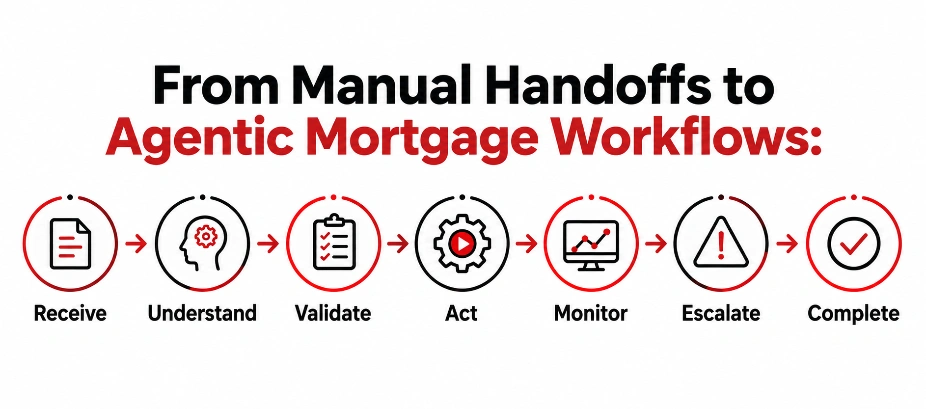
This creates a workflow such as:
The agent does not need unrestricted authority to manage this sequence. Instead, lenders can define specific permissions, data access, decision thresholds, and escalation rules.
Moving From Tasks to Outcomes
This is where agentic AI differs from traditional mortgage automation. A conventional automation generally performs an action when a specific condition is met. An agent can work toward a broader objective by coordinating several actions within defined boundaries.
For mortgage operations, those objectives could include preparing a complete underwriting file, identifying any outstanding closing conditions, or ensuring that required documentation is ready for post-closing review.
This approach can make automation more responsive without removing accountability from mortgage professionals.
Agentic AI for Faster, More Accurate Mortgage Processing
Reducing Operational Bottlenecks
Mortgage processing delays often stem from small issues that accumulate across a loan file. Missing documents, inconsistent data, repeated verification, and manual handoffs can each add time to the process.
Agentic AI can help address these bottlenecks by coordinating routine activities, identifying exceptions earlier, and connecting document, data, validation, and workflow capabilities to broader operational goals.
This approach can reduce unnecessary handoffs, keep routine files moving, and direct mortgage professionals toward cases that require review or judgment.
Supporting Accuracy Alongside Speed
Faster processing is useful only when accuracy and control are maintained. Through Mortgage Automation Services, lenders can use intelligent workflows to compare information across documents, flag inconsistencies, validate loan data, and route cases outside defined parameters.
This approach improves efficiency by allowing routine cases to progress with minimal manual intervention, while mortgage professionals receive alerts for files that need attention. Lenders can simplify processing without sacrificing oversight on complex workflows.
Human-in-the-Loop Governance for Agentic Mortgage AI
Defining Clear Boundaries
Greater autonomy requires stronger controls. Mortgage lenders should determine what an agent can access, what actions it can perform, and which situations require employee intervention.
A practical governance framework should include:
- Defined permissions: Restrict access to systems and data.
- Decision thresholds: Establish which actions can occur automatically.
- Exception routing: Escalate ambiguous or unusual cases.
- Audit trails: Record actions, inputs, and outcomes.
- Human override: Allow authorized employees to stop or reverse workflows.
- Performance monitoring: Review accuracy, exceptions, and unexpected behavior.
Keeping People Accountable
Agentic AI should support mortgage professionals while maintaining clear accountability. Through Mortgage Operations Services, lenders can combine intelligent assistance with human oversight, ensuring employees remain involved when cases require interpretation, investigation, or decisions that fall outside predefined parameters.
This human-in-the-loop approach also allows lenders to introduce agentic capabilities incrementally. Teams can begin with narrowly defined workflows, evaluate results, and expand agent responsibilities as governance frameworks and operational processes mature.
The Future of Agentic AI in Mortgage Operations
Agentic AI is likely to become another layer in the mortgage technology stack, working alongside existing automation rather than replacing it. Its value lies in coordinating data, systems, rules, and people across workflows that currently depend on multiple manual handoffs.
For mortgage operations leaders, the opportunity lies in identifying repetitive processes, frequent handoffs, and recurring exceptions where greater coordination can make a measurable difference. High-volume, rule-bounded workflows can provide a practical starting point, while complex decisions remain under human oversight.
As these capabilities mature, mortgage operations can move from automating individual tasks to managing connected workflows more intelligently. The goal is not greater autonomy for its own sake, but faster, more consistent processing with the right level of human judgment and control.
Discuss Your Mortgage Automation Needs
Flatworld Solutions supports mortgage teams with document processing, workflow automation, exception handling, and specialist review across defined loan-processing activities.
Talk to an Expert